Third-year UoP history student Elliott Thomas examines the surprisingly pragmatic relationship between Catholic Venice and the Islamic Ottoman Empire, which caused the Venetians first to fight against the Ottomans at the Battle of Lepanto in defence of Cyprus, and then, motivated by economic considerations, to betray their Catholic allies in signing a peace treaty with the Turks resulting in three-quarters of a century of détente.
One of the most consequential events of the end of the medieval period was the fourth crusade (1202-1204), where crusaders were ferried by the Venetians to sack the city of Constantinople.[1] This sacking would cause the collapse of the Byzantine Empire into a series of Latin and Greek states, and whilst the Byzantine Empire would eventually reforge, it would never again achieve the heights it once had, poisoning relations between the western and eastern Christian worlds.[2]
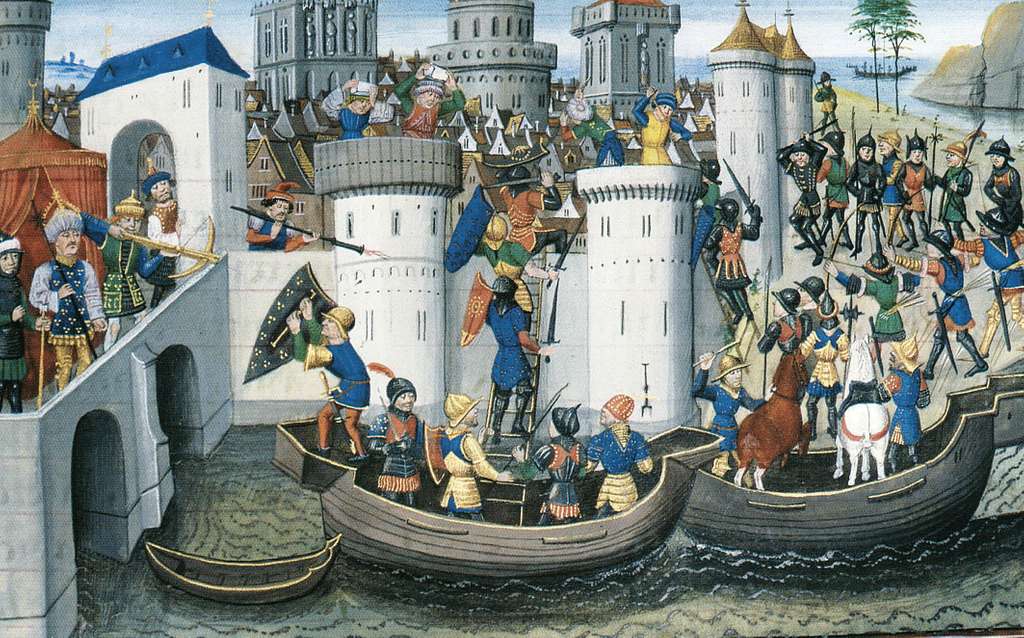
David Aubert (1449-79), 15th century miniature showing the sack of Constantinople in 1204, encouraged by the Venetians.
The Venetians, under their Doge Enrico Dandolo, negotiated their way into the lion’s share of the spoils, taking the island of Crete, the Ionian and Cycladic islands and scattered fortresses across what is now Greece.[3] As Byzantine authority waivered over the centuries, a new threat that would come to haunt Europe would emerge on the plains of Anatolia : the Ottomans.[4] Through careful diplomacy and conquest, the Ottomans expanded westwards and eastwards, eventually taking Constantinople in 1453 to the elation of Muslims and the horror of Christians.[5] The conquest of the old imperial city would allow the Ottomans to proclaim themselves the inheritors of the Roman Empire, not only pronouncing themselves as a mediterranean power but pitting them in a brutal rivalry with the Christian powers of the west – particularly the Habsburgs who ruled the Holy Roman Empire.[6] Yet Venice often proved hesitant to join the holy crusades called upon against the Turk, and even when it did join coalitions (such as the Holy League in the 1570s) it quickly abandoned them when the costs to its coffers seemed too high.[7] This blog post seeks to explore the Venetian-Ottoman relationship, particularly focusing on the conflict over Cyprus between 1570-1573.

The reception of Venetian ambassadors in Damascus’, 1511, The Louvre
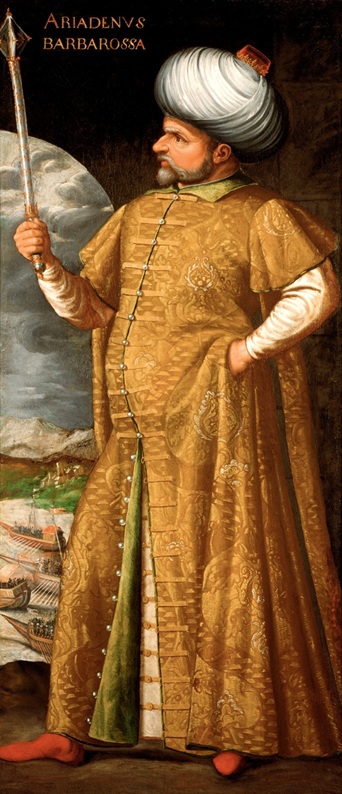
Ottoman general Hayreddin Barbarossa, c. 1580
Venice’s empire in the eastern Mediterranean revolved around its trade links with the east: vast quantities of goods were transported from Venetian colonies in the Levant to Venice proper using islands such as Cyprus.[8] Whilst these trade routes were insanely profitable for Venice, they were vulnerable to the piracy that was commonplace as Muslim corsairs raided the Venetian routes just as Christian pirates looted Muslim trade routes.[9] Venetian naval security was increasingly eroded as the plucky Ottoman navy gained more expertise from admirals such as Hayreddin Barbarossa who helped conquer the central Cycladic islands for the sultan in 1537. Alongside that the Ottomans were able to capture some Venetian carracks (large ships, used famously by the Portuguese to reach India) which they used to great effect capturing Lesbos in 1462 thanks to their bombardment abilities.[10] Ottoman shipyards wouldn’t be able to produce these types of ships until the end of the 15th century, yet the fact they not only stole them but used them to great effect alarmed the Venetian Senate, which promptly considered a 1454 treaty voided and entered a war footing, for which it would wear a crusader aesthetic which it usually shied away from.[11]
Venice tended to avoid military action in the Mediterranean unless absolutely necessary; it often only joined coalitions against the Ottomans when its back was up against the wall. In 1463 for example, the Senate ordered that the cross be added to the standard of its patron saint (Mark), and a golden standard displaying Saint Mark, the cross and the inscription in hoc signo vinces was blessed in the church of Saint Mark.[12] However it only introduced this religious crusader aesthetic after war with the Ottomans seemed inevitable, as it had previously forbade Pope Pius II from holding his 1459 crusading congress in Udine and banned crusader rhetoric in its realm.[13] This flip-flopping between crusader stance and a preaching of détente for economic gain meant that Venice developed a reputation for untrustworthiness amongst anti-Ottoman circles.[14] A manuscript titled Viaje de Turquia presented to Philip II of Spain in 1557, denounced the Venetians stating that whilst they were Catholic, they were traitors.[15]
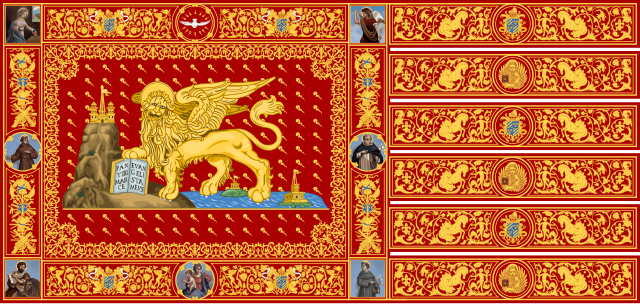
The Venetian Standard has sometimes included a Lion bearing a cross, sometimes not.
Cyprus was considered the crown jewel of the Venetian empire, and a thorn in the side of the Ottomans.[16] They had gained Cyprus through marrying into the Lusignan dynasty which had ruled the island since the 1190s, and it soon became an important mercantile hub, and, to the Ottomans, a staging ground for Christian piracy and potential Christian crusades.[17] Venice had similar disdain for piracy, as it was often the victim of it, yet corrupt officials on Cyprus often enabled pirates to refit or even sell their booty.[18] At the same time of this growing Ottoman frustration, Pope Pius V in January 1566 attempted to revive the spirits of the medieval crusade, beginning to court Mediterranean powers into forming a holy alliance to counter the Ottomans.[19] Venice was not convinced to join this alliance: it did not want to risk its lucrative trade relations with the Ottomans, it also did not want to give ammunition to the Pashas in the Ottoman court who were more hawkish and eager to conquer Venetian territories in the Levant.[20] In the 1560s, signs of a conflict about to erupt began blaring: from 1567, the islands of Tremiti and Cyprus saw an uptick of Ottoman spies being captured, and on September 23 1569 a 600 feet-high fortification wall and monastery detonated thanks to sabotage inside the Venetian Arsenal, causing timber to disperse all over the lagoon of Venice.[21] The Venetians accused the Ottomans of the sabotage, another stepping stone into the seemingly inevitable conflict.[22] The Ottomans soon invaded in 1570, causing the Venetians to appeal to the Pope for aid, an opportunity Pius would not waste.[23] Pius would garner a coalition titled the Holy League, which included Venice and the other major Christian power in the Mediterranean: Spain and its Habsburg empire.[24] The Ottomans would sweep across the island of Cyprus, eventually taking the last fortress of Famagusta in 1571 – yet the jubilation of the conquest would not last long, as the League fleet, under Don Juan of Austria would inflict a landslide victory against the Ottoman fleet in the gulf of Lepanto on October 7,1571 – a lightning rod of ecstasy for the Christians.[25]
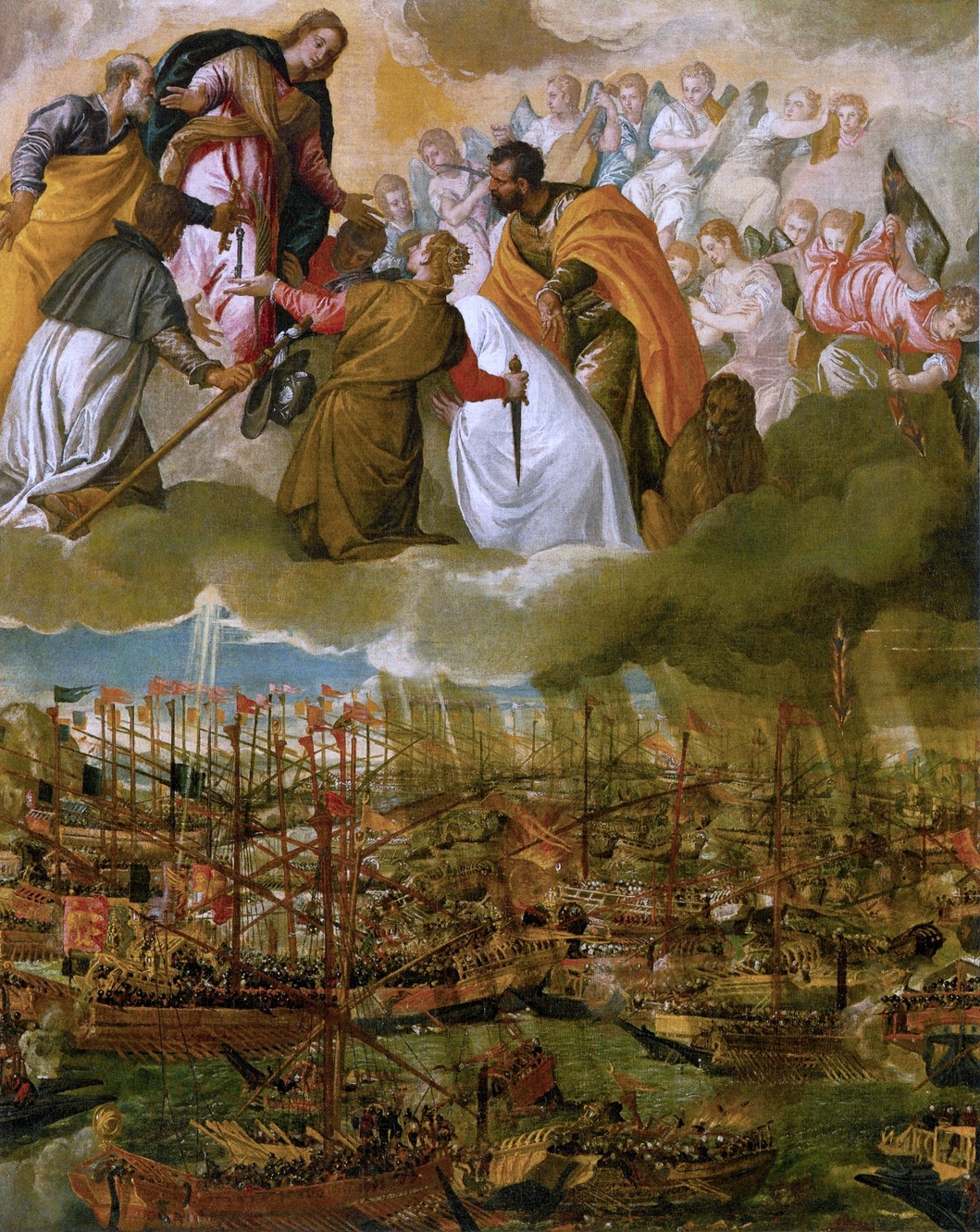
The Battle of Lepanto by Paolo Veronese, Accademia Gallery, Venice. Venice is depicted as a shrouded woman in white, introduced to the Virgin Mary by Saints Justina and Saint Mark. The divine favour bestowed on the Catholic fleet is underlined by the bright rays singling out the victors’ ships while dark shadows torment the enemy Ottoman ships.
Yet concern for Venice’s finances soon began to arise after this battle which tainted the celebrations: the loss of Cyprus was devasting, but the cost of a prolonged naval conflict with the Ottomans would cost even more – as the Ottomans were able to rebuild their navy quite swiftly after Lepanto.[26] The Ottomans and Venetians signed a peace treaty in March 1573, officialising the fall of Cyprus and Venice’s leaving of the Holy League.[27]
Venice fought six wars against the Ottomans in 1463-1479,1499-1500,1537-1540,1570-1571,1645-1669-1684 and 1715-1718, with the longest peace being between 1571-1645.[28] The Venetian concern for trade and economics in the longest interval often led to the Venetian ambassador awkwardly diminishing the incidents of piracy by Venetian subjects in order not to provoke the Sultan.[29]
European attitudes towards the Ottomans was often negative, seeing their claims of being the inheritors of Rome false, alongside their religion being aligned with the devil – which often caused the Christian powers to fight with religious fervor in order to assert themselves.[30] Yet Venice often proved an outlier, hosting the only community of Ottoman Muslims in Europe, whilst also sharing a close trading partnership with the Ottomans during peace time- with Venetians settling and intermarrying into local Christian families.[31] By looking at Venetian relations with the Ottomans, it can not only provide a looking glass into the geopolitics of the Early Modern Mediterranean, but also the various ways of how the European powers c
[1] Siriol Davies and Jack L. Davis “Greeks, Venice, and the Ottoman Empire”. In Hesperia Supplements, 40 (2007): 25 .
[2] Dennis P. Hupchick The Balkans, from Constantinople to Communism (Palgrave, 2001), 71.
[3] Davies and Davis “Greeks, Venice, and the Ottoman Empire”: 25-26.
[4] Davies and Davis “Greeks, Venice, and the Ottoman Empire”, 25; Hupchick, Balkans: 101.
[5] James E. Baldwin “European relations with the Ottoman world”. In The European world 1500-1800: an introduction to Early Modern History. Ed. Beat Kumin (Routledge, 2017), 173.
[6] Ibid.
[7] Emrah Naki, “Conquest of Cyprus by the Turks: divergence of the Early Modern Period and establishment of status quo in the Mediterranean”. Journal of Gazi Academic View 13, no. 25 (2019): 299.
[8] Ibid: 288-289.
[9] Ibid.
[10] Stefan Stantchev, “Devado: The Venetian response to sultan Mehmed II in the Venetian-Ottoman Conflict of 1462-79″. In Mediterranean Studies 19 (2010): 50.
[11] Ibid.
[12] Ibid: 53-54.
[13] Ibid.
[14] Naki, “Conquest”: 289.
[15] Ibid.
[16] Svatopluk Soucek, “Naval aspects of the Ottoman conquests of Rhodes, Cyprus and Crete”. Studia Islamica, 98/99 (2004): 226.
[17] Davies and Davis “Greeks, Venice, and the Ottoman Empire”: 29; Soucek, “Naval aspects”: 226.
[18] Soucek, “Naval aspects”: 226.
[19] Naki, “Conquest”: 288.
[20] Naki, “Conquest”: 288-289.
[21] Naki, “Conquest”: 290-291.
[22] Ibid., 291.
[23] Ibid., 294.
[24] Ibid.
[25] Ibid., 299.
[26] Ibid.
[27] Davies and Davis “Greeks, Venice, and the Ottoman Empire”: 29; Soucek, “Naval aspects”: 29. Naki, “Conquest”: 299.
[28] Davies and Davis “Greeks, Venice, and the Ottoman Empire”: 26.
[29] Ibid.
[30] Roger Crowley, Empires of the Sea, the final battle for the Mediterranean, 1521-1580 (Faber and Faber, 2008), 10-11; Rana Kabbani. Europe’s Myths of Orient (Macmillan, 1986), 5.
[31] Baldwin “European relations”, 178.
No comments yet.