A level studies in history and media led Damiana Kun to focus her Portsmouth history dissertation on how a patriarchal screen industry has ignored modern research and continued to attach negative stereotypes to one of history’s most famous and complex women. Damiana’s supervisor was Dr Maria Cannon.
Whether someone has a deep interest in history or not, many remember the six wives of the Tudor King Henry VIII by the old English nursery rhyme: “Divorced, Beheaded, Died, Divorced, Beheaded, Survived.” However, in popular culture, Anne Boleyn is perhaps the best known out of the six wives, as the one who supplanted a long-time wife and queen and set a nation in turmoil when Henry broke England away from the Roman Catholic Church, allowing the rise of the English Reformation. Anne’s perceived sexual appeal has always been the centre focus of her fascination, becoming notorious wife from her tarnished image caused by the vicious slander of Catholic propaganda during her lifetime which condemned her as the scheming seductress who used her sexuality to influence the King. Even to this day, conflicting political and sexual ideologies have been ingrained upon Anne’s life and body.
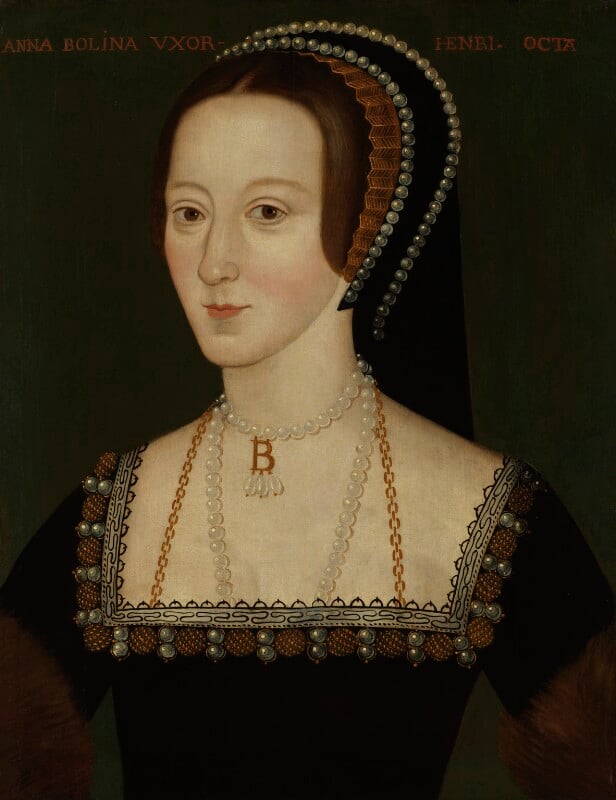
16th century portrait of Anne Boleyn, National Portrait Gallery, NPG 668
Throughout my dissertation, I examined how Anne is represented on-screen in the 20th and 21st century, linking the screen interpretations of Anne with themes of sexuality and agency. My aim was to investigate how these portrayals of Anne had evolved and whether they continued to interpret her character as the ambitious schemer constructed by Catholic propaganda. What I concluded was that the majority of on-screen representations of Anne had the tendency to uphold this one-dimensional character. The overarching factors that I found for this were the patriarchal dominance in the film industry, the constrained gender roles of women, the social anxieties over female agency and sexuality during the second wave feminism and the contradictory nature of post-feminist culture in the 21st century.
My fascination with the Tudors, especially Anne Boleyn, stemmed from my studies in A level History. It was during that time I learned about her through many readings and documentaries which revealed the discussions about the controversies surrounding the second wife of Henry VIII. Anne’s story of rising through the Tudor court to become the most powerful woman in England in 1533 after six long years of struggle with Henry to divorce his first wife Catherine of Aragon, only to be executed unjustly three years later, is so profound and remains to captivate academics and the public alike. Anne as a cultural icon is evident through the numerous books, novels, plays, films and television series portraying her story, revealing the extent of her presence in the public imagination. When it was time to decide on the topic for my dissertation, I knew I wanted to base my research on this English Queen, specifically through the concept of gender.
Many historians, such as E.W. Ives and Maria Dowling, have produced various works on the life and death of Anne. However, when it came to how Anne is portrayed on-screen, it was evident that this research was mostly unexplored. One of the few texts that thoroughly explored all depictions of Anne from the 16th century to the 21st century is Stephanie Russo’s book The Afterlife of Anne Boleyn: Representations of Anne Boleyn in Fiction and on the Screen, published in 2020. Her book helped to interlink how the fictional on-screen and literary representations influence each other within the historical context of the evolving attitudes regarding women’s sexuality, agency and power.[1] Other historians such as Susan Bordo narrowed their focus on one particular representation. By analysing the portrayal of Anne in the famous TV series The Tudors (2007-2010), Bordo argued that whilst there is some complexity to Anne’s character, her oversexualisation rendered Anne as the scheming seducer.[2] These works provided me with the foundation in understanding on how gender roles of women played a crucial role as to why the Catholic propaganda had been predominantly left unchallenged in fictional interpretations of Anne.
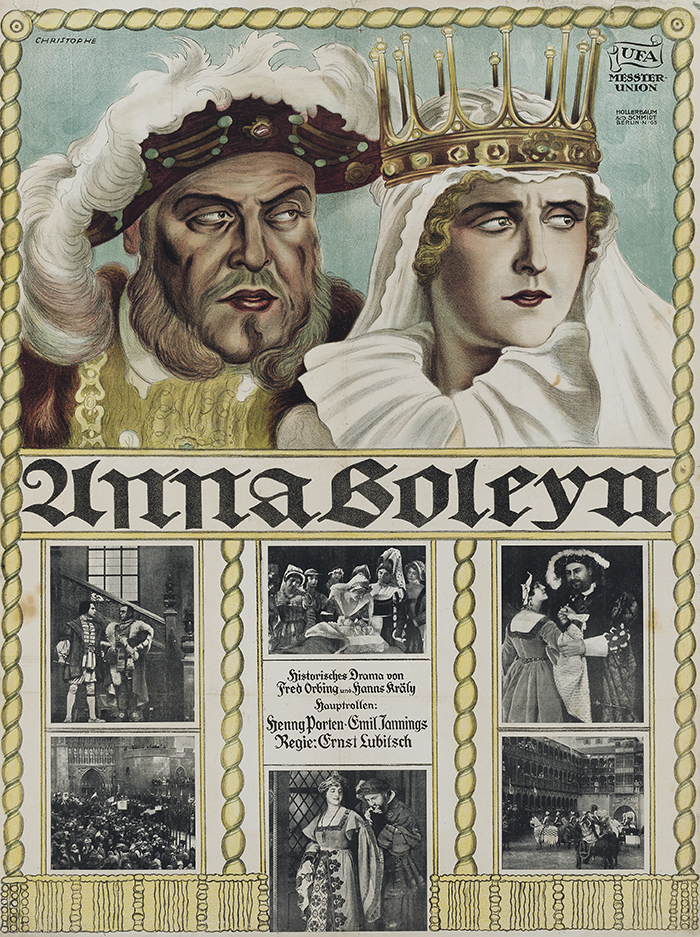
Poster for the 1920 German film Anna Boleyn, by a director later to become famous in Hollywood, Ernst Lubitsch
Whilst these historians delivered historical context, I noticed their works lacked in exploring the patriarchal aspect of the film industry as another contributing factor for the continued sexualisation and defamation of Anne. I took this opportunity to use my passion and understanding of the film industry from my A level Media studies for my dissertation. Therefore, I included media theorists such as Laura Mulvey to highlight the film industry’s sexualisation of women and female characters and how they are used as objects for the male gaze and for upholding conservative attitudes regarding gender roles.
With the abundance of research studies on Anne, finding secondary sources was no challenge. In fact, that was the challenge at first. Even though I was determined to have Anne as my subject matter, I was unsure if I was able to do it due to the amount of research already done on her. Fortunately, the topic I chose had areas which were mostly under researched, allowing my dissertation to provide a new perspective on how Anne is remembered in popular culture in the 20th and 21st century. Primary sources were also of no difficulty to find because there are vast numbers of films and TV shows which were accessible online.
Working on my dissertation was a positive and rewarding experience, a fitting closure to my three years at Portsmouth University. This project allowed me to combine my love for history and film as well as to push my creativity in order to offer a new viewpoint regarding a historical figure that is generally well researched. My dissertation expanded my understanding of popular culture and showed me that despite living in an age that prides itself for social progressiveness, the case of Anne Boleyn reveals that the vilification of women still persists.
[1] Stephanie Russo, The Afterlife of Anne Boleyn: Representations of Anne Boleyn in Fiction and on the Screen. Queenship and Power (Cham: Palgrave Macmillan, 2020),160.
[2] Susan Bordo, “The Tudors, Natalie Dormer, and Our “Default” Anne Boleyn,” in History, Fiction, and the Tudors: Sex, Politics, Power, and Artistic License in the Showtime Television Series ed. William B. Robison. (New York: Palgrave Macmillan, 2016), 91.
No comments yet.