James Farrar finished his history studies at Portsmouth in 2021. Although James had always been set on a career in teaching, he decided to gain some hands on experience before studying for his PGCert, which he is planning to gain next year, via the more practical School-Centred Initial Teacher Training (SCITT) route. Below he describes some of the highs and lows of his past four years gaining experience as a teaching assistant, student engagement worker, and cover supervisor, an honest and humorous appraisal (there seems to be a lavatorial theme!) which should be invaluable to current students aiming to follow a similar career trajectory.
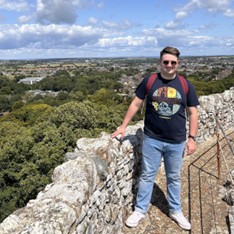
James atop Carisbrooke Castle (IoW) where Charles I was held captive during the English Civil War.
Time flies when you are having fun, or when you work in education. How on earth has it been nearly five years since I graduated? It still feels like I have an essay due around the corner! Studying History at the University of Portsmouth set me up on the right path to succeed in post-graduate life. I decided early on that I wanted to be a teacher and I have spent the last few years gaining invaluable experience hands-on in the classroom, first as a Student Engagement Worker (similar to a traditional teaching assistant) and currently as a Cover Supervisor teaching a variety of subjects to students from Year 7 to 11 in the absence of their usual teacher.
Working in secondary education is tough, but can be so rewarding and eye-opening. Apart from sharing tales from the past with the next generation, there is a real sense of purpose and community. You really do feel you are here to make a positive difference to young people’s lives. I had a great lesson with Year 7 who were studying the Norman Invasion of England. This was a topic I knew very little about before going into the classroom and I decided to make it as interactive as possible to further facilitate students’ understanding. The lesson was on The Battle of Hastings so I got one class member to be Harold Godwinson, another William of Normandy, a group to be Harold’s soldiers (using their books as shields) and another group to be William’s cavalry. We reenacted the key events of the battle: Harold’s shield wall, the Norman’s feigned retreat, and then Harold’s demise and William’s victory. I will never forget this lesson!
There are some crazy moments working in education but the good moments counteract these. I have come across a blazer being flushed down a toilet, a Year 11 walking down the corridor holding a toilet cubicle door, and someone setting the fire-alarm off during a named storm (that was NOT fun!). However, when you successfully help a Year 8 and they say: “thank you for teaching me that Sir, I got the answer right”, it really makes you feel on top of the world.
Studying History at Portsmouth has further developed my own personal and professional appreciation of the subject. Last year I travelled to Leeds Castle with Year 8 where they learnt lots about Henry VIII and one of them even dressed up as Groom of the Stool – I invite you to Google this unfortunate’s job! The lecturers at Portsmouth have instilled in me a constant desire to be inquisitive, always justify my arguments with evidence, and to never stop looking back in time. I enjoy challenging students when they present an argument as it is always important for them to understand the other side of the story and how the same evidence can be used for different agendas.
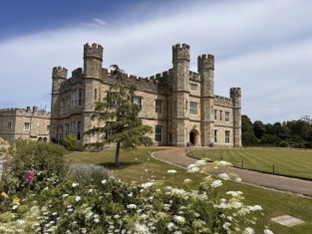
Leeds Castle in Kent which James visited on a trip with Year 8
At the time of writing (Friday evening – I am already in my pyjamas and it is not even six o’clock) I have had a day full of ups and downs. Lots of students have worked their socks off but some needed reminding to be their best selves. This is the nature of working in education; it has two distinct sides, positive and negative. But this is the nature of history too. History never stops, it never ends; the past reveals there have been lots of successes but also countless disasters. It is our collective responsibility, as historians, to navigate the chaos of the past and guide the next generation towards reaching an even greater understanding of these events than we ever could.
Read the blog James wrote in 2021 about his dissertation research on female transgression and cheap literature here.
Compare James’s teaching experiences with those of Ashleigh Hufton here.
No comments yet.