For their second-year Working with the Past project, UoP history students Daniel Rickler and Sebastian Burgess chose to research the history of crime and punishment in Hampshire. In contemporary Britain, we have moved beyond the need to deter crime through humiliation, physical punishment and execution. But as we look to Hampshire from the 1600s onwards, we see a brutal and bloody history including, in Portsmouth in 1782, the last person to be hung, drawn and quartered for treason. Daniel and Sebastian examined both the wider policies of government and individual cases alongside the ritualistic nature of these punishments, to show how unnecessary they were and how far we’ve evolved. Both […]
Tag Archives | eighteenth century
Charting The Perilous Deep
Below, our own Karl Bell, Associate Professor in Cultural and Social History, writes about his exciting new book on the supernatural legends associated with the seafarers of the Atlantic Ocean. Karl’s research specialises in supernatural and environmental history, the history of beliefs and mentalities, folklore, and Victorian popular culture, on which he has published extensively. The modules Karl teaches at Portsmouth include a third-year special subject on Magic and Modernity, a new second-year option on The Age of Crisis and Victorian Enchantments for the MA in Victorian Gothic: History, Literature and Culture. My new book, The Perilous Deep – A Supernatural History of the Atlantic (Reaktion Books) offers a different […]
‘Jazzed Up’: the origins and impact of jazz in America
Miles Orr’s dissertation explored the origins of jazz by examining the lives and lyrics of three key African-American artists: Louis Armstrong, Dizzy Gillespie, Buddy Bolden. Miles’s supervisor was Dr Lee Sartain, who has a special interest in Louisiana’s history – see his recent blog post on Louisiana’s civil rights activism. Miles is continuing to master’s study, where he will research Louis Armstrong’s life and influence in more detail. Louis Armstrong, Dizzy Gillespie, Buddy Bolden – African Americans who were part of an era of racial segregation, music and culture. This dissertation aimed to explore and uncover the origins of jazz music in America, tracing it back to its African roots […]
Histories of Adulthood in Britain and the United States
In November 2024 our own Dr Maria Cannon published an edited collection Adulthood in Britain and the United States from 1350 to Generation Z in the Royal Historical Society’s New Historical Perspectives series published by the University of London Press. Laura Tisdall, Senior Lecturer at Newcastle University, was Maria’s co-editor. The collection looks at how ideas of adulthood have changed over the centuries and addresses two central questions: who gets to be an adult, and who decides? The chapters in the collection cover more than 600 years and two continents and are focused around four key themes: adulthood as both burden and benefit; adulthood as a relational category; collective versus individual […]
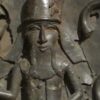
An African slave trading commodity washed up off the Isle of Wight
Many of our UoP history students take the opportunity to do voluntary work in one of the many museums in Portsmouth or nearby. Second-year UoP History Isobel Turtle started volunteering even earlier. Having decided to defer her university entry, she started working at the Isle of Wight shipwreck centre in 2021. It’s given her lots of unique opportunities to learn how a museum works: highlights have included seeing how a museum becomes accredited by the Arts Council, how grants and funding are secured and used, how exhibitions are created from scratch, working on databasing the collection, helping with visiting school groups and managing volunteers. She has worked her way up […]
Getting creative with early modern history
In a previous post, Dr Katy Gibbons looked at how second-year students studying the Debating the Past module, translated Natalie Davis’s book The Return of Martin Guerre into other media: emojis, memes and poetry. Our first-year students in the Beliefs, Communities and Conflicts: Europe 1400-1750 module are also set an assessment asking them to employ the imaginative use of media to explore a theme relating to their studies on the module. Below we look at two great responses to this. Having initially thought about crocheting an item or artwork from the early modern period (!), Megan Conway decided to produce a comic. Visual formats often make it easier to take in […]