By Charlie Wilkinson Southsea’s well was built in 1544, abandoned in 1814, covered over during later modifications and then rediscovered in the 1960s. That means it sat unused for over 150 years, during which: the garrison changed, the fort was remodelled, obsolete artillery (including stone shot) was discarded, domestic waste accumulated. This blog discusses three objects that were discovered inside the well at Southsea Castle: a wooden bucket and pulley, stone cannon balls and pottery flask fragments. Object 1: Wooden bucket and pulley system The original well was built against the inside of the Tudor curtain wall and equipped with a simple pulley block, an oak bucket, and a […]
Tag Archives | material culture
Realising and communicating a love for history, at Portsmouth and beyond
Ashleigh Hufton is remembered with great affection by the history team as a student who contributed keenly to history seminars from the outset and worked hard to develop her skills further during her studies in history at the University of Portsmouth from 2018 – 2021. Ashleigh has since been enjoying great success teaching history at secondary level. Below she writes about her studies at Portsmouth, and what she has gained from them since graduating. What I enjoyed most about my history studies at Portsmouth It is difficult to pinpoint the most enjoyable part of my degree because I genuinely loved every moment of being a student at the University […]
An African slave trading commodity washed up off the Isle of Wight
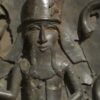
Many of our UoP history students take the opportunity to do voluntary work in one of the many museums in Portsmouth or nearby. Second-year UoP History Isobel Turtle started volunteering even earlier. Having decided to defer her university entry, she started working at the Isle of Wight shipwreck centre in 2021. It’s given her lots of unique opportunities to learn how a museum works: highlights have included seeing how a museum becomes accredited by the Arts Council, how grants and funding are secured and used, how exhibitions are created from scratch, working on databasing the collection, helping with visiting school groups and managing volunteers. She has worked her way up […]
Communal music on board the Mary Rose: the significance and after-life of a shawm
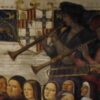
For the second year module, The Hidden Lives of Things, taught by Dr Katy Gibbons and Dr Mary Cannon, for their assessment, students have to produce an ‘object biography’ for a historical artefact. Francesca Raine chose to look at one of the ten surviving musical instruments found on the Mary Rose and what it can tell us about how sixteen-century people experienced and enjoyed music. In 1545 the Mary Rose, a Tudor carrack, sank during a confrontation with the French fleet in Portsmouth.[1] The unusual underwater conditions preserved a unique snapshot of everyday Tudor life, revealed in the 20th century, despite earlier excavation attempts in 1545 and 1836-1840.[2] […]
Creating an identity through clothing: a Renaissance merchant’s fashion book
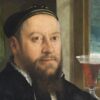
For the second year UoP History module, The Hidden Lives of Things, taught by Dr Katy Gibbons and Dr Mary Cannon, for their assessment, students have to produce an ‘object biography’ for a historical artefact. Sadie White chose a sixteen-century German fashion book. Described as “The First Book of Fashion,” Matthäus Schwarz of Augsburg’s Klaidungsbüchlein or Trachtenbuch or “Book of Clothes” is a fascinating object.[1] This object biography explores Schwarz’s reason for producing this book, entangling ideas of self-reflection linked to the Renaissance, the importance of clothes and the idea of sentimentality. It will explore the book’s lifecycle and how someone’s relationship with an object can change its function and importance. Throughout, […]
The Lost Crafts of the Past
As part of their work on the second year core module ‘Working with the Past’, three University of Portsmouth History students – Chanel Parker, Loraya Head, and Gemma Norris – collaborated with Portsmouth Museum and Art Gallery to curate a three-month exhibition that both celebrated the crafts of our ancestors and highlighted the importance of preserving the craftspeoples’ skills for future generations. In this blog, written for Hampshire Archives Trust, Chanel Parker discusses the research methods the group used when curating the exhibition. ‘Working with the Past’ is coordinated by Mike Esbester. To read the blog, click this link. Slider image courtesy of Birmingham Museums Trust