For her third-year dissertation UoP history student Sadie White looked into representations of the French Queen Catherine de’ Medici, one of several late-sixteenth century female rulers famously denounced by John Knox in his First Blast of the Trumpet against the Monstrous Regiment of Women (1558). As Sadie describes, Catherine, foreign, from a family considered inferior in status to the French monarchy, no great looker, and barren for the first ten years of her marriage, has had a hard press over the years, both in her own time, and still today, as represented in contemporary TV and film drama. She is a salutary reminder of how female rule continues to be depicted negatively. Sadie’s supervisor was Dr Katy Gibbons.
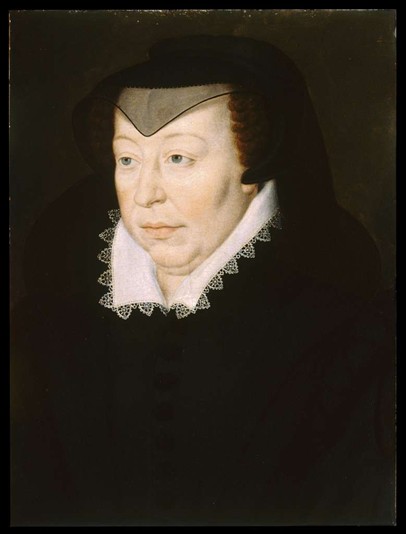
Portrait of Catherine de’ Medici by François Clouet, c. 1580s .
Catherine De Medici played a part in ruling France for around thirty years after her husband, King Henri II of France died. She played key roles as advisor or Queen regent for her three sons, who all ruled France. She is an intriguing, fascinating and often reviled individual in French history as despite this stronghold of influence, she was largely unpopular throughout her period of ruling and afterwards. However, her reputation is riddled with misconceptions, judgments and stereotypes.
I wanted to address the misrepresentations that have often marred Catherine de’ Medici’s reputation. I wanted to tackle this by looking at the key issues that were often detrimental to her public representations. I explored key themes of gender and motherhood, her Italian heritage from the famous Florentine merchants and the xenophobic stereotypes that accompanied this. Alongside these specific issues, I also looked at the broader issue that caused Catherine’s position to often be attacked, France’s political and religious situation, with the French Wars of Religion raging on for most of Catherine’s regencies.
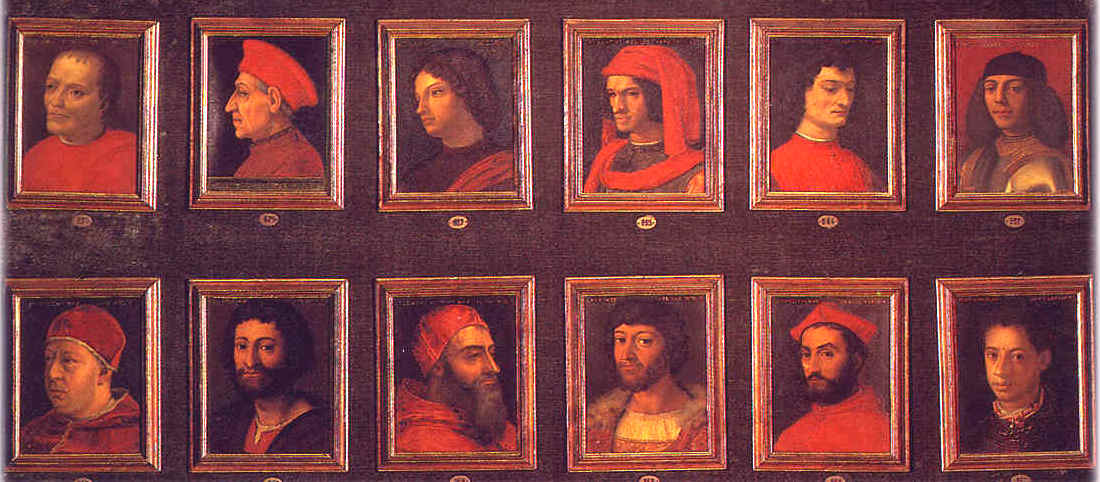
Catherine was a member of the powerful Florentine Medici family, originally bankers, sponsors of artists such as Botticelli and Michelangelo. This painting, from the workshop of Bronzino, is in the Uffizi Gallery in Florence.
The odds were stacked against Catherine, an Italian Woman in power in the sixteenth-century, trying to broker peace in a hugely religiously divided country. These specificities made Catherine a complex but hugely rewarding character to analyse and explore for my dissertation. I used different sources that described her person, from ambassador reports and how they perceived her in the sixteenth century, alongside pamphlets or polemics that were published, speaking out against Catherine and her ‘evil influence’ over the French and her sons.
Catherine has often been described as France’s ‘scapegoat’ throughout this tumultuous period, particularly when it came to the tragedy of the St Bartholomew Massacre in 1572. This massacre led to many French protestants being slaughtered in Paris, and much of the discourse following the bloody event blamed Catherine. However, more recent historiography brands this narrative as highly unlikely. If this has been recognised, then why have popular culture representations of this prolific French queen been slow to catch up?
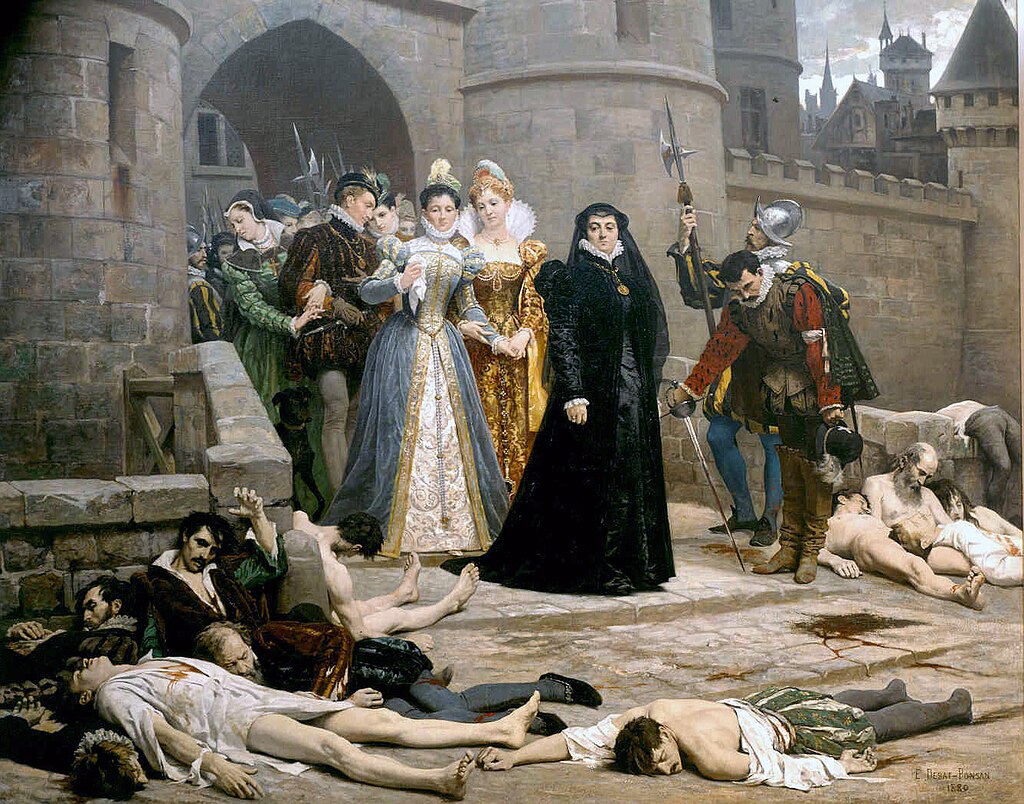
19th-century painting of Catherine and the St Bartholomew’s Day Massacre by Édouard Debat-Ponsan. https://www.clermontmetropole.eu/bouger-se-divertir/le-dynamisme-culturel/les-musees-de-clermont-auvergne-metropole/marq-musee-dart-roger-quilliot/
The second part of my dissertation posed this question and therefore focused on the popular culture surrounding Catherine de’Medici. When I was younger I watched a TV series called Reign, which is set at the French court at the time of Catherine’s first son’s reign. This was my first time encountering Catherine de’ Medici, and her character in the show is less than likeable; in fact, she is pretty much portrayed as a villain. From then on my interest in her as an individual developed, and I felt that from this it was important to analyse how Catherine continues to be shown as the ‘villain’ in French history, and try to discover why film and TV have continued to use Catherine as the ‘scapegoat.’
This meant that I took on quite a range of different primary sources, with chapter two of my dissertation looking at contemporary representations of Catherine, compared to chapter three, which used two main primary sources of modern film and TV. By taking this approach to my dissertation, I could understand how historical misrepresentations manifest themselves within historical narratives, and how often they fail to be adjusted by popular culture. I really enjoyed writing chapter three of my dissertation and not using ‘traditional’ historical sources. I analysed both a French film, La Reine Margot and a newer US period drama, The Serpent Queen. Analysing a film and TV show was vastly different to the types of sources I was used to examining, and at points I found this challenging. However, ultimately, I found this chapter the most rewarding and enjoyable to write. By comparing the representation of Catherine in film and TV to her representations in sixteenth century polemics or pamphlets, it highlights that her individual history has largely stagnated. Catherine de’ Medici is still largely presented as a Machiavellian, obsessive mother who would poison and kill her enemies to stay in control of France. Popular culture has held onto this narrative formed in the sixteenth century, and despite The Serpent Queen attempting ‘revisionism,’ it falls back on centuries-old myths, such as Catherine de’ Medici killing the protestant Queen of Navarre, with poisoned gloves.
Overall, I feel this dissertation was important to research not only in regards to Catherine de’ Medici, but also perhaps other female historical figures. Due to the specificity of the early modern period, many have been plagued with misrepresentations and stereotypes of ‘female rule,’ which in many aspects still exist today. It is important, particularly when studying history, to try to challenge these ingrained stereotypes, and through my research of Catherine, I can confidently state she was a complex and intelligent individual. Her lasting legacy deserves more than a reductionist description of an ‘evil and obsessive mother.’
Is there any way to read this dissertation with the author’s consent? The subject matter is one I have an interest in and I’d love to learn more.
Hi Aaliyah,
You can download this dissertation at:
https://library.port.ac.uk/dissert/dis2109767
Fiona McCall