For their second-year Working with the Past project, four UoP history students carried out research into the women of the Mary Rose. Three of the students, Mel Slama-Hardy, Serena Ablett and Evelyn Blackmore-Tagg, then presented their research at the Portsmouth 100 celebrations in October. Their project tutor was Dr Maria Cannon. Below we discuss what they discovered.
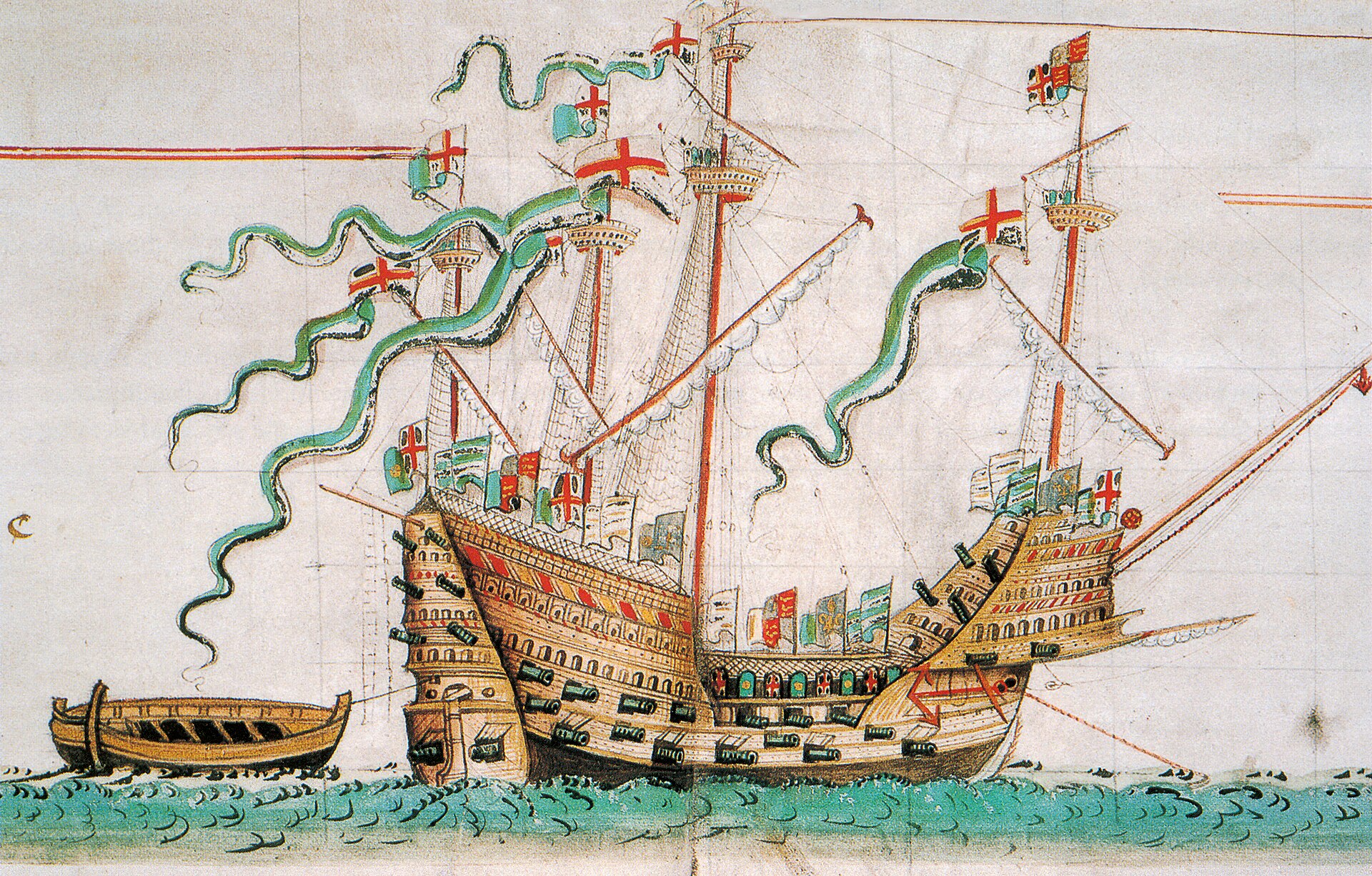
The Mary Rose, from the Anthony Roll, Pepys Library, Magdelene College Cambridge
Alehouses, Alewomen, and Brewsters
Mel Slama-Hardy comes from a naval family and has lived in Portsmouth for much of her life, with visits to the Historic Dockyard an integral part of her own and her children and grandchildren’s childhoods, so was immediately attracted to the prospect of researching the women of the Mary Rose.
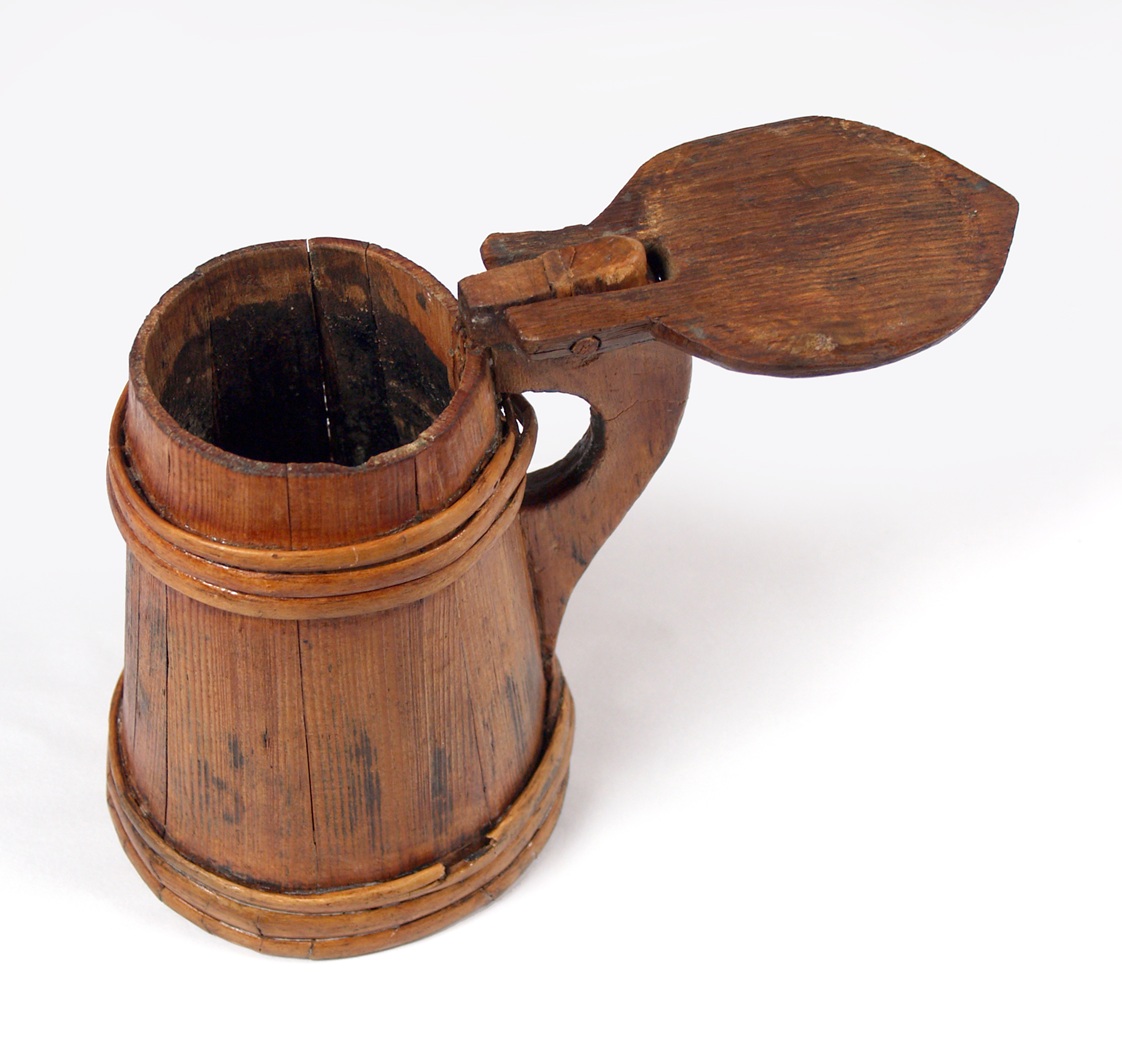
Wooden tankard from the Mary Rose Museum
To shape her research, she chose a tankard and the Cowdray engraving as her primary sources, and then carried out wider reading to understand women’s roles in brewing at this time. In 1516, the production of over 500 barrels of ale a day was overseen by women in Portsmouth. But women began to lose their role in brewing. Women brewed unhopped ale, but the newer hopped ale became a masculine industry. Victualling (on a Portsmouth site known as “The Greyhound”) facilitated the production of beer that was made in larger quantities and would travel further without spoiling. “Women still brewed Ale, yet they were never part of the lucrative industry of brewing Ship beer”, writes Judith Bennett [1] They were removed from the new, larger-scale industry (not just in Portsmouth but also in Port towns such as Southampton too), and like other women in history, their knowledge was passed on to men. The local community, however, continued to rely on alewives who brewed in their homes and sold the excess. This was signalled by women with a broom and or leafy greenery outside their homes to signal fresh Ale for sale. “Alehouses could provide an arena for fellowship and bonding through the media of dancing, eating, drinking, gaming and conversing”, writes Mark Hailwood, but the combination of women and drink was increasingly stigmatised.[2]
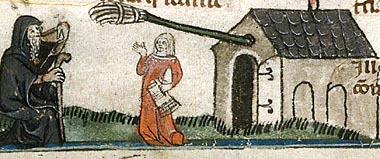
Depiction of an alewife and her broom from the Smithfield Decretals, c. 1300, British Library shelfmark Royal 10 E. IV, Wikimedia Commons
Food on the Mary Rose and its production in the surrounding community
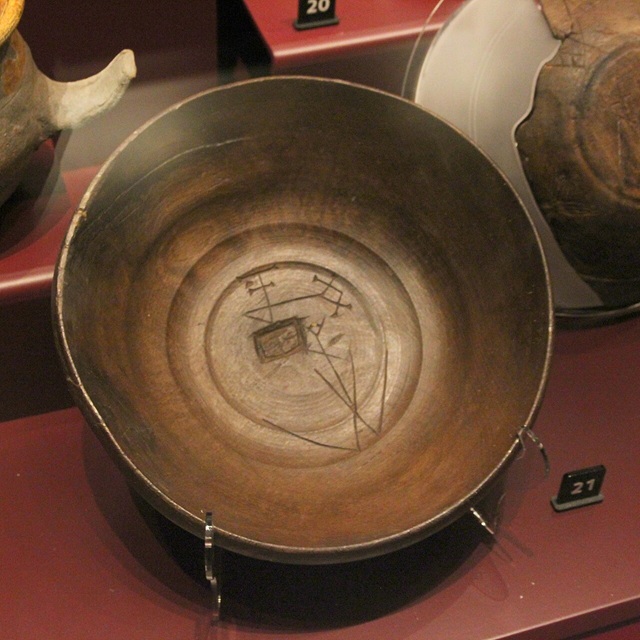
Beech wooden bowl, Mary Rose Museum
Serena Ablett researched this topic. Eating was an important part of everyday life on the ship: the sailors required plenty of food to support manual work. Their diet consisted of salted meats, such as beef and pork, as well as dried or baked produce, although evidence from analysis of their bones shows they often suffered from lack of vitamins C and D, giving them rickets or scurvy. Although there is no evidence of women on board the Mary Rose, women did contribute to the production of food supplied to ships, as women of the time undertook a third of work in the agricultural category and forty-two percent of food processing. Women sold food from workshops or farms. Bread was a staple in diets during this time. Sailors consumed normal soft bread in port but while at sea ate ship’s biscuit, which was baked in local bakeries, such as Swane Bakery which is found on a map of Portsmouth. Widows might assume their husband’s businesses: for example there is evidence for a widow running a slaughterhouse in Southampton.
Noble women of The Mary Rose
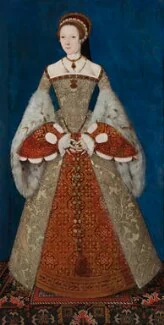
Katherine Parr, National Portrait Gallery NPG 4451
Evelyn Blackmore-Tagg researched this topic. 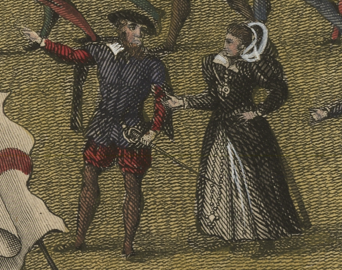 The Cowdray engraving clearly depicts women in the presence of Britain’s most influential and significant officers, dressed in higher-class clothing, such as headpieces and veils. Fashion was integral to the life and self-expression of the nobles at the time. Evelyn found similarities between the dress of one of the women on the Cowdray manuscript to a portrait of Queen Catherine Parr – the hood, the style of dress, and jewelry. Women are depicted wearing crosses and pendants, as seen in various portraits of noble women across the Tudor period.
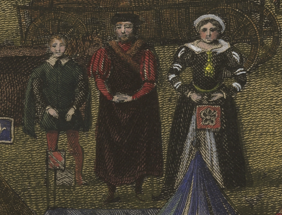
Cowdray Manuscript: The Governor’s family
This image of the governor and his wife shows a traditional family and Christian values. Not much is known about the role of noble women in connection with the navy: although we do know that Lady Mary Carew witnessed the sinking of the Mary Rose:
The King, this meanwhile, stood on the land, and saw this tragedy, as also the lady, the wife of Sir George Carew, who with that sight fell into a swooning.
The King, being oppressed with sorrow of every side, comforted her, and thanked God for the other, hoping that of a hard beginning, there would follow a better ending.
John Hooker, The Life of Sir Peter Carew (16th century, published 1857)
Conclusions
The students concluded that women were a vital part of economic and social life of Tudor Portsmouth. Elite women had political roles supporting the King and his government. Many women worked in industries producing food and drink for the Navy and the town. Women both influenced local and national economies, and their lives were shaped by wider political and economic changes across the 16th century.
Further reading
Primary sources
Beech Wooden Bowl. Artefacts. The Mary Rose Museum. 82A1712.
Beef Bones. Artefacts. The Mary Rose Museum.
Tankard. Artefacts. The Mary Rose Museum. 81A3915.
Venison Bones. Collections. The Mary Rose Museum.
Jane Seymour after Hans Holbein the Younger oil panel c. 1537.
Letters and Papers, Foreign and Domestic, of the reign of Henry VIII, preserved in the Public Record Office. Vol. Addenda Vol. I, Part I,, Entry no. 110, London, England: His Majesty’s Stationery Office, 1929. Crown Copyright
Mary Rose Trust. “The ‘Cowdray Engraving.’” Mary Rose.
Secondary sources
Museum of Oxford. “Alewives in Oxford: A History of Female Brewing.” Museum of Oxford.
Ågren, Maria. Making a Living, Making a Difference: Gender and Work in Early Modern European Society. Oxford: Oxford University Press, 2017.
Bennett, Judith M. Ale, Beer, and Brewsters in England: Women’s Work in a Changing World, 1300-1600. New York: Oxford University Press,1996.
Capp, Bernard. When Gossips Meet: Women, Family and Neighbourhood in Early Modern England. Oxford: Oxford University Press, 2003.
Eleri, Lynn. Tudor Fashion. Yale University Press, 2017.
Eley, Phillip. Portsmouth Breweries, 1492–1847. Portsmouth Papers no. 51. Portsmouth: Portsmouth City Council, n.d.
Fontana, Dominic. Mapping Portsmouth’s. PDF booklet.
Fontana, Dominic. Old Portsmouth.
Gentilcore, David. “Rich Food, Poor Food: Diet, Physiology and Social Rank”. In Food and Health in Early Modern Europe: Diet, Medicine and Society, 1450-1800. London:Bloomsbury Academic, 2015.
Hailwood, Mark. Alehouses and Good Fellowship in Early Modern England. Boydell & Brewer, 2014.
Hanawalt, Barbara A. The Wealth of Wives: Women, Law, and Economy in Late Medieval London. Oxford University Press, 2007.
Harris, Barbara. “Women and politics in early Tudor England,”, The Historical Journal 33 no. 2 (1990): 259-281.
Hayes, Patrick et al . “European Naval Diets in the Sixteenth Century: A Quantitative Method for Comparative and Nutritional Analysis.”, Historical Methods: A Journal of Quantitative and Interdisciplinary History 52, no.4 (2019): 195-212.
Lloyd, Paul S., Food and Identity in England, 1540-1640: Eating to Impress. London: Bloomsbury Publishing.
Richardson, Catherine. “As my whole trust in him”: Jewellery and the Quality of Early Modern Relationships, University of Michigan Press (2011).
Toth, Savannah. Under the Veil: Women’s Head Coverings in Tudor England. University of Nebraska-Lincoln Thesis (2025):1-25
No comments yet.