English Civil War royalism has often been depicted as the preserve of the elite, but this was not necessarily the case, as MRes student Natalie Lejeune found in her research into the activities of gunmakers during and after the civil wars. Prior royal service often inclined these specialist craftsmen towards the Royalists initially. After the Royalist defeat, they transferred their work to a new Republican Government prepared to tolerate their dubious loyalties in exchange for their much-needed skills. Yet their loyalties remained conflicted, with some, including female-gunmakers as well as men, secretly supplying arms to Royalist conspiracists on the side, a pattern of mixed loyalties which mirrors those in France during the Nazi Occupation. Natalie’s supervisor was Dr Fiona McCall.
In 1642 England descended into civil war when Parliament attempted to curb the power of a king who believed he ruled by divine right and possessed absolute authority. The problem of defining and discerning allegiance has long been debated in the literature, particularly whether royalism was shaped by conviction, pragmatism, or circumstance. McElligott and Smith’s definition, that a Royalist was one who both identified and was recognised as such by others, provided the framework for this study.[1]
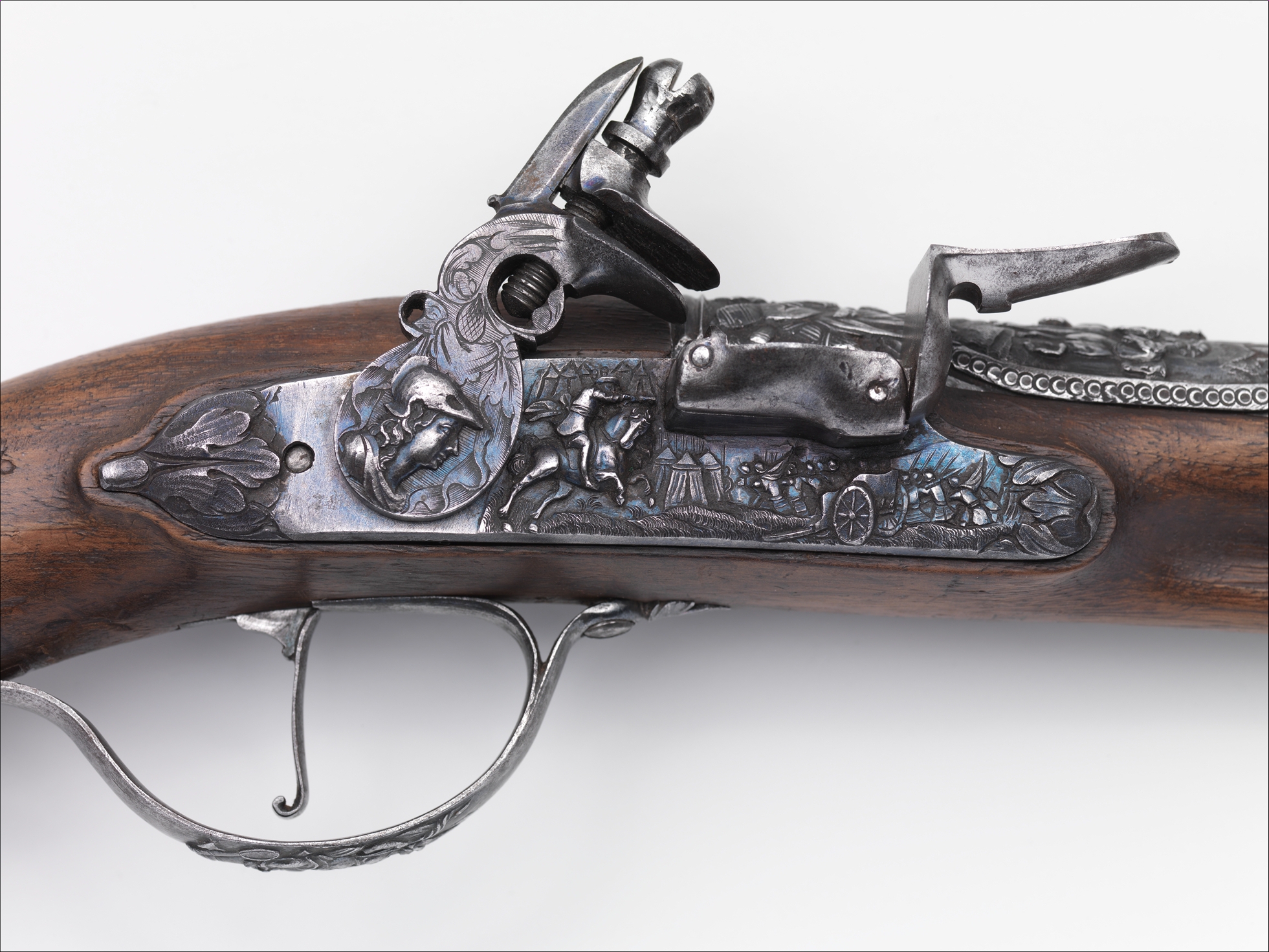
Detail from a Belgian flintlock pistol, showing scenes of early 17th century warfare, demonstrating the craftsmanship of these pieces: there is a keen contemporary online market for pieces by George Fisher, discussed below. Source: Metropolitan Museum New York, DP271593
This project set out to investigate whether evidence could be found for artisans participating in Royalist resistance after their defeat by Parliament, focusing specifically on a group of London gunmakers who appeared to conform outwardly to Parliament’s rule. Determining allegiance, is especially challenging for the craftsman class, who rarely left extensive written records. The motivation for examining this subject arose from genealogical research into a London gunmaker and his wider professional and social networks.
From 1642 to 1646 the conflict took the form of overt war. After Parliament’s victory in 1646, Royalists were excluded from government office, leaving them with a stark choice: retreat into quiet obscurity, or participate in a covert resistance that concealed latent allegiance until circumstances allowed active involvement. This was a pattern closely resembling that of many members of the French resistance during the Second World War.

Johan van Haensbergen, Portrait of a 17th century man with a pistol; National Trust, Nostell Priory.
The historiography of Royalist resistance has traditionally characterised it as ineffective, pointing to a series of failed conspiracies and abortive uprisings.[2] More recent theories of resistance, however, have demonstrated that non-violent forms are more effective (newsletter propaganda, fraud, economic survival, covert networks).[3]
For my research into the gunmakers, a case study approach was adopted: this method is particularly suitable where evidence is fragmentary. Primary sources included Ordnance Office accounts, State Papers, parish registers, probate records, and the archives of the Gunmakers Company. Additional sources, such as personal letters and memoirs, newsletters, tax and militia lists, and prisoner lists, were consulted where relevant.
Whilst invaluable, these sources are often incomplete, or biased by the political context in which they were produced. They may deliberately omit compromising details or obscure allegiances for personal safety. Communication was necessarily discreet, often never written down, and as studies of the Second World War have shown, even decades later participants often retained an ingrained habit of silence.[4] In the Restoration period, the Act of Oblivion discouraged testimony, enforcing silence about past experience and allegiance. Jonadab Holloway’s initial petition for royal posts after the Restoration leaned heavily on his repeated arrests and imprisonments, suggesting a man who wished his Royalist identity to be visible, at least retrospectively. Thomas Flaxwell’s arrests and suspected involvement in coining rendered him politically exposed, Harman Barnes, by contrast, compounded for a modest estate in 1650, only for his will a decade later to reveal wealth more than ten times greater. Whether this represents concealment or recovery, it demonstrates the difficulty of reading political loyalty directly from financial records.
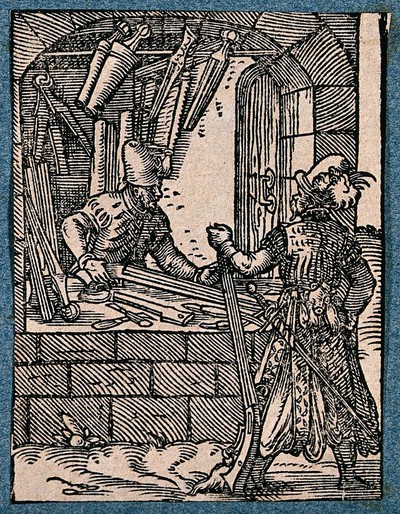
A gunsmith’s shop: a customer talks to the gunsmith, while an assistant works metal in a furnace. Woodcut by J. Amman. Source: Wellcome Collection
Alice Shambrooke’s case presents perhaps the greatest ambiguity: married to a radical Independent and Parliamentarian military commander, she later appears to have been implicated in fraud and perhaps in Royalist networks, although this may equally reflect pragmatism and a concern for business survival. George Fisher, meanwhile, appeared for years to exemplify Parliamentary service, receiving gratuities for diligence, yet was rewarded at the Restoration by prominent Royalists whose own resistance credentials were unquestionable.
In each case, allegiance cannot be read straightforwardly from the surviving evidence. Silence, concealment, and ambiguity may themselves have functioned as survival strategies. This confirms insights from resistance studies: covert and non-violent resistance often leaves the faintest archival traces, requiring historians to interpret absence as well as presence. Patronage was important, but so too were pragmatism, reputation, and the protective alliances of colleagues.
Another central finding concerns the role of women. Historians of women and the Civil Wars, notably Hughes, McCall, and Worthen, have demonstrated how women petitioned, protested, and participated in wartime society.[5] This study has shown that women were not passive placeholders but active participants in sustaining workshops, securing Ordnance contracts, and managing apprentices. Elizabeth Holloway, Ursula Barnes, Alice Shambrooke, and Margarett Fisher all continued businesses after widowhood. In Alice’s case, this continuation intersected directly with questions of allegiance: her alleged fraud and connections with Royalist sympathisers blur the line between opportunism and political sympathy.
Women’s economic agency intersected with political allegiance in three ways. First, it made them visible to institutions. Second, it placed them in a position where economic choices had political consequences: supplying arms was never neutral. Third, it created opportunities for divergence distinct from their husband’s opinions. Gunmaking therefore provides a striking test case for rethinking women’s wartime economic and political roles.
By reassessing the contribution of London gunmakers to Royalist survival, the role of patronage and networks were tested, the agency of widows was highlighted, and the boundary between pragmatism and conviction was examined. While definitive proof of allegiance was not always attainable, the cumulative evidence supports a more nuanced view of Royalist resistance as sustained through this group of craftsmen whose skills the state could not afford to lose.
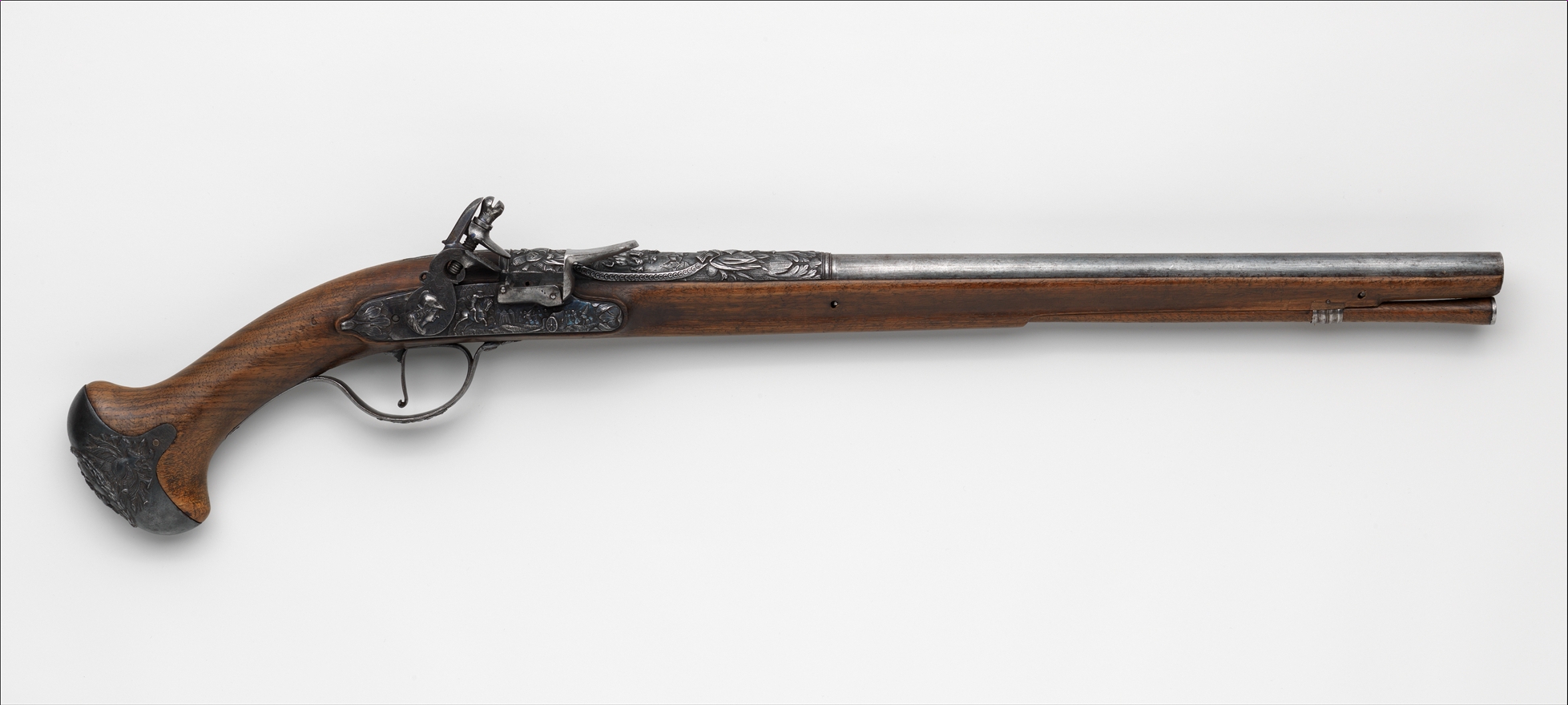
Full photograph of the 17th century Belgian pistol whose detail is shown above. Source: Metropolitan Museum New York, DP271593
[1]Jason McElligott and David L. Smith (eds.) “Rethinking royalists and royalism.” In Royalists and Royalism during the English Civil Wars (Cambridge University Press, 2007) 13.
[2] David Underdown, Royalist Conspiracy in England, 1649-1660 (New Haven: Yale University Press, 1960) 7; Alan Marshall, Intelligence and espionage in the English Republic c.1600-60 (Manchester: Manchester University Press, 2023) 98;
[3] Erica Chenoweth and Maria Stephan, Why Civil Resistance Works: The Strategic Logic of Nonviolent Conflict (New York: Columbia University Press, 2011); Laurent Douzou, “A Perilous History: A Historiographical Essay on the French Resistance.” Contemporary European History, Feb 2019, Vol. 28 Issue 1, 96-106.
[4] Lawrence L. Langer, “Combat Trauma, Memory, and the World War II Veteran,” The Oral History Review 19, no. 1/2 (1991): 65–83.
[5] Ann Hughes, “Society and the Roles of Women,” in The Oxford Handbook of Literature and the English Revolution, ed. Laura Lunger Knoppers (Oxford: Oxford University Press, 2012; Fiona McCall, “Women’s Experience of Violence and Suffering as Represented in Loyalist Accounts of the English Civil War.” Women’s History Review 28 (7, 2019): 1136–56; Hannah Worthen, The Experience of War Widows in Mid Seventeenth-Century England, with Special Reference to Kent and Sussex (PhD thesis, University of Leicester, 2017) 17.
No comments yet.