This is the first of two blogs by UoP second-year history student Gabriel Lawless, reflecting on the 50th anniversary of the reunification of Vietnam. This blog, drawing on oral histories, poetry, and political writing, explores how African-American voices interpreted and responded to the My Lai Massacre and the Fall of Saigon not as isolated incidents, but as part of a wider, politically entrenched pattern of violence. The exposure of the My Lai Massacre in 1969 to the civilian masses marked a decisive turning point in public perception of the Vietnam War. Reports that American soldiers had supposedly killed hundreds of Vietnamese civilians came as a shock to those in the United States. Now, with hindsight, we can understand that for African-American communities, their reaction was shaped by a more extensive history of racial injustice. Gabriel wrote this blog for the second-year Working with the Past Module, run by Dr Mike Esbester. Gabriel’s tutor for this module was Professor Dave Andress. Note that this post includes graphic description of war-time atrocities.
By now, it is established that Black soldiers often questioned their role in a war fought in the name of freedom whilst they continued to face discrimination at home. African-American responses to My Lai were deeply influenced by the broader context of racial inequality of the period, which had intensified for many African-American soldiers fighting in Vietnam. Vietnam was labelled the “first integrated war.”[1] But due to the heightened racism experienced in Vietnam, African-Americans soldiers were often victim to discriminatory language and sights of the confederate flag blowing in the wind. Black soldiers were disproportionately assigned to front-line combat roles, a factor correlated to social inequalities back home. With this context, news of the massacre did not simply produce shock, but rather reinforced existing doubts about the ethical and moral foundations of the war and the United States government.
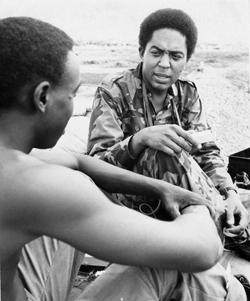
Wallace Terry interviewing a G.I. in Vietnam, 1969. Source: Wikimedia Commons
Wallace Terry’s Bloods: Black Veterans of the Vietnam War: An Oral History provides some of the most direct primary sources of these perspectives. Whilst also an African-American himself, Terry served as a reporter for Time magazine and first arrived in Vietnam in the spring of 1967. Whilst this is the same year Terry’s infamous Time cover story The Negro in Vietnam was written, Bloods: An Oral History wouldn’t be published until much later, in 1984. In Bloods the reader is presented with a series of transcribed oral interviews; these 20 veterans recount their experiences in Vietnam with indescribable intimacy and personality and can only be aptly described as a treasure trove and gift of insight.
In the early days of U.S. involvement in Vietnam, African-Americans often were largely apathetic or apathetic to their situation, such as Captain Norman Alexander McDaniel who spoke on their deployment. “It was [July 1966] just seven days short of my 29th birthday. I had come a half world away from Fayetteville, North Carolina […] to die in North Vietnam at the hands of peasants.”[2] As it will become evident, these emotions are a recurring theme within the testimonies of Bloods. In addition to McDaniel’s testimony, if we wish to examine one with from a non-commissioned soldier, we have the musings of Private First Class Reginald “Malik” Edwards who describes the horrific scenes he witnessed, and participated in, at Cam Ne, Danang. Edwards implies the US army has a complete disregard for international law,
When you’re in combat you can basically do what you want as long as you don’t get caught. You can get away with murder. […] there’s always somebody who can serve up as a scapegoat. Like Calley. I wondered why they didn’t get Delta Company 1-9 because of Cam Ne. We were real scared. […] But like that was before My Lai. When they did My Lai, I got nervous again, I said my God, and they have us on film.[3]
The Calley that Edwards is referring to here is William Calley, a US Officer who, whilst originally charged alongside 25 other soldiers for what transpired at My Lai, was the sole individual prosecuted for war crimes, in this case the murder of 22 unarmed South Vietnamese civilians. Due to the common prejudice faced by African-American within the armed forces of the 1960s, many were surprised when a white officer was found guilty and sentenced at all. Edwards’s recollection of Cam Ne reads largely with a sense of apathy, describing his unit’s morbid curiosity in desiring to see the mutilated bodies of civilians in an attack gone wrong.[4]
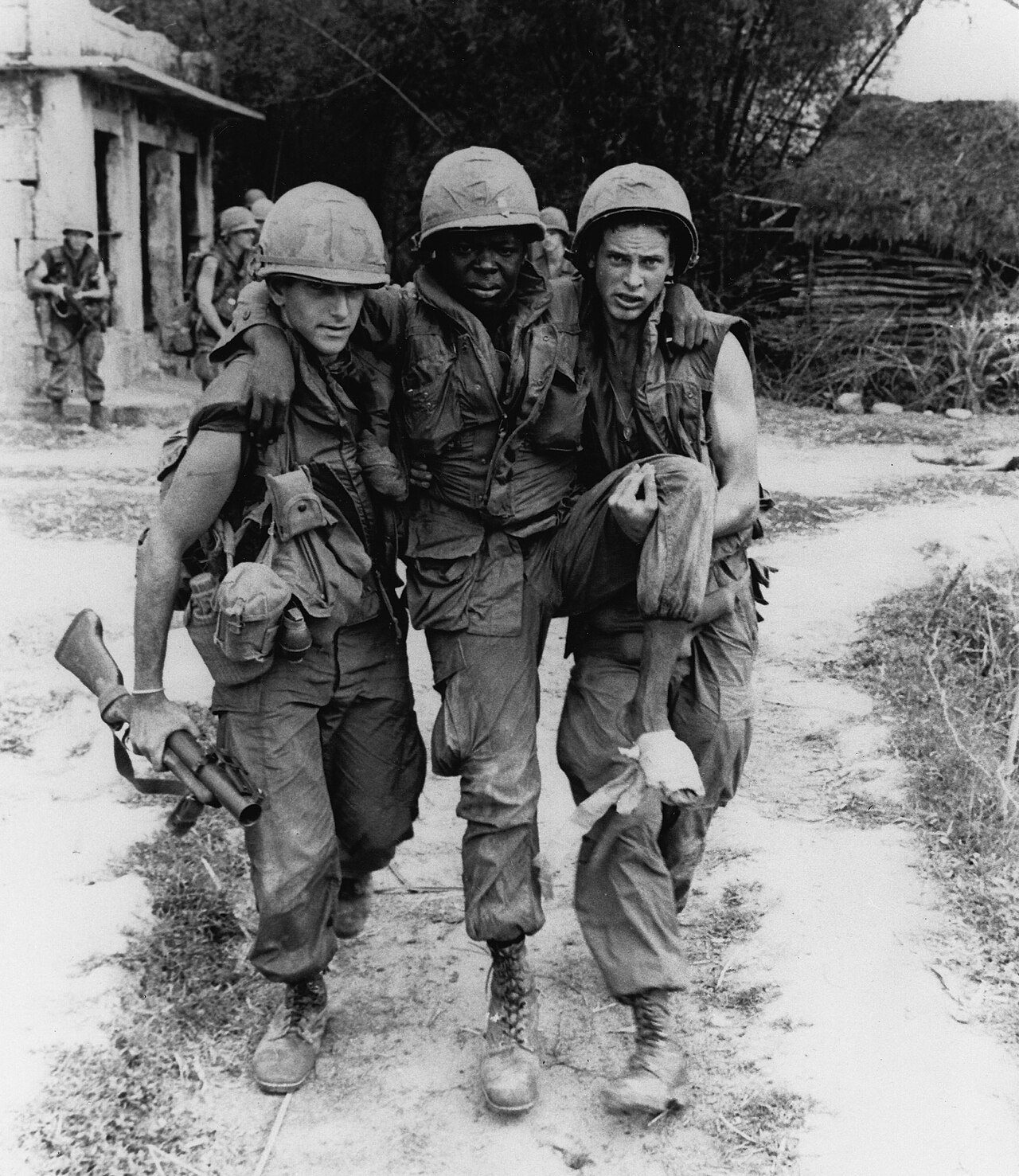
This photo shows American soldiers in Vietnam, probaly taken on March 16, 1968, by official Army photographer Ron Haeberle during the events at My Lai, part of photographic evidence documenting the My Lai massacre, where between 347 and 504 unarmed civilians were killed. Haeberle was an official Army photographer traveling with Charlie Company into the My Lai region. Source: Wikimedia Commons.
I used to think that I wasn’t affected by Vietnam, but I been livin’ with Vietnam ever since I left. You just can’t get rid of it. It’s like that painting of what Dali did of melting clocks. It’s a persistent memory. I remember most how hard it was to just shoot people.[5]
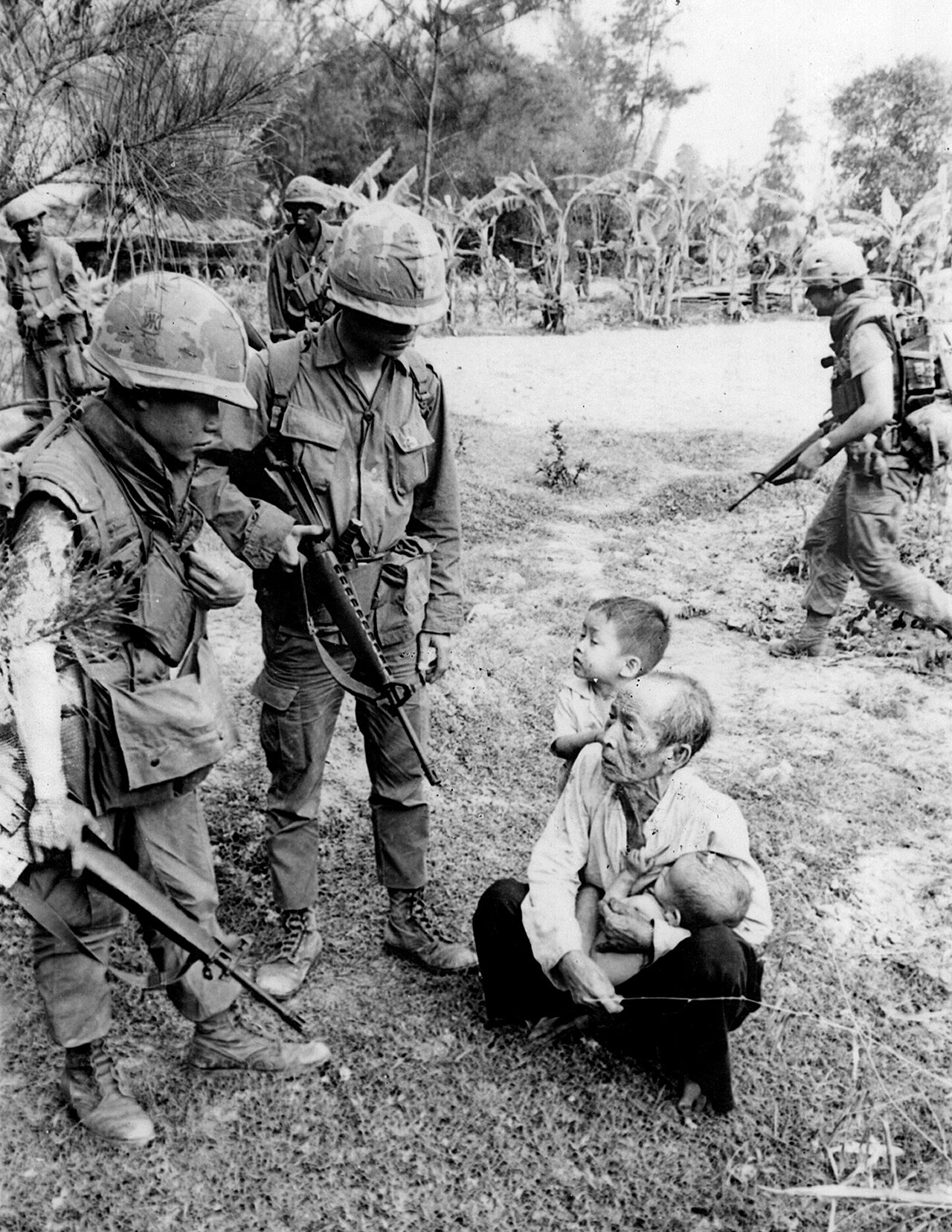
American soldiers interrogate an old man and two children, one an infant at the time of the My Lai massacre. Two African-American soldiers are present in the background. Photograph by Ronald L. Haeberle, 1968, source: Wikimedia Commons
With Edwards’s testimony, the widespread nature of the pattern of violence in Vietnam becomes evident. African-American soldiers who felt persecuted at home were now present at the heart of the atrocities being committed far from home. Perhaps this is why Edwards regards his time in Vietnam as so stripping of his individuality,
I had left one war and came back to another [in reference to joining the Black Panthers]. We had already fought for the white man in Vietnam. It was clearly his war.[6]
Ultimately, large portions of the seminal events typical of the 1960s cycle of violence, such as the King Assassination Riots, the Cam Ne Massacre, and My Lai Massacre, would all happen in the latter half of the decade.
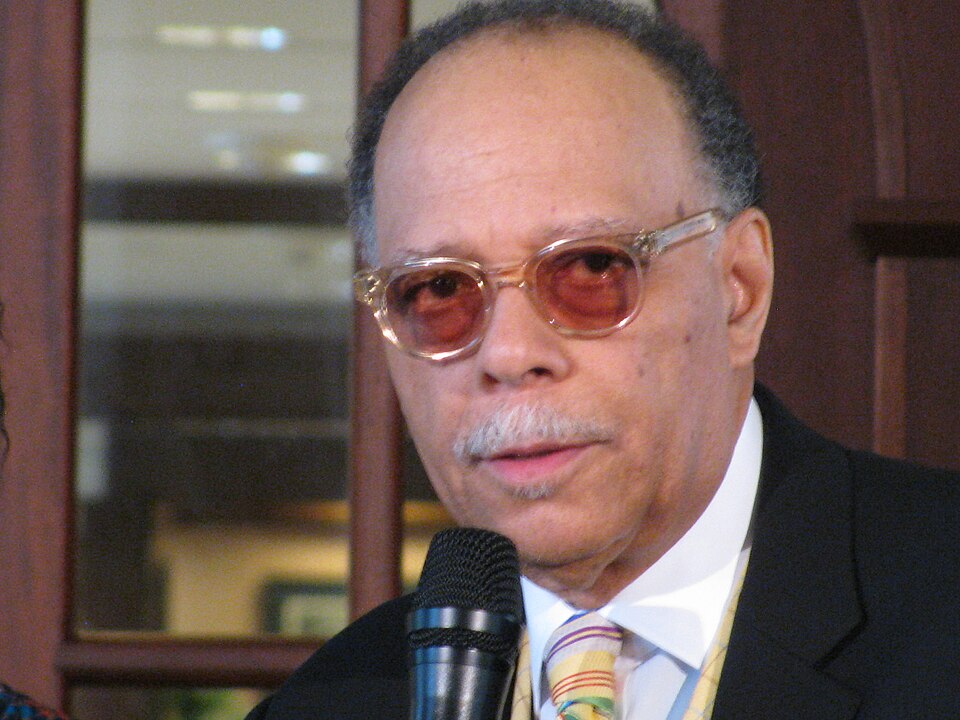
Haki R. Madhubuti (born Don Luther Lee on February 23, 1942) is an African-American author, educator, and poet, publisher and lecturer. Source: Wikipedia
The 1960s was categorised by a rapidly evolving arts scene, and the emergence of the Black Arts Movement in the mid-1960s, being comprised of many notable figures such as Haki R. Madhubuti. By choosing to reflect on various events, rather than just one, Madhubuti situates the Vietnam War within the 1960s global framework of racial oppression and resistance. His poem “Don’t Cry, Scream” reflects the broader political response within the Black Arts Movement, and by extension, represented many African-Americans. His urgent tone and direct address convey a sense of anger and disillusionment, linking the violence in Vietnam to struggles for racial justice in the United States, whilst the turbulent swaying structure of the poem reflects the uncertainty of the period. Several lines are snappy and direct; “it hurts, grown babies dying.”, “brother, they were too busy getting into debt, expressing humanity & taking off color.”, all whilst the recurring presence of all capitalised ‘screams’ throughout the poem exasperate the sense of repeated tragedy.[7] Combined with the fact this poem was published just one year after the My Lai Massacre, the perspectives and styles present reinforce the idea that My Lai was understood not in isolation, but as part of a wider system of inequality and domination.
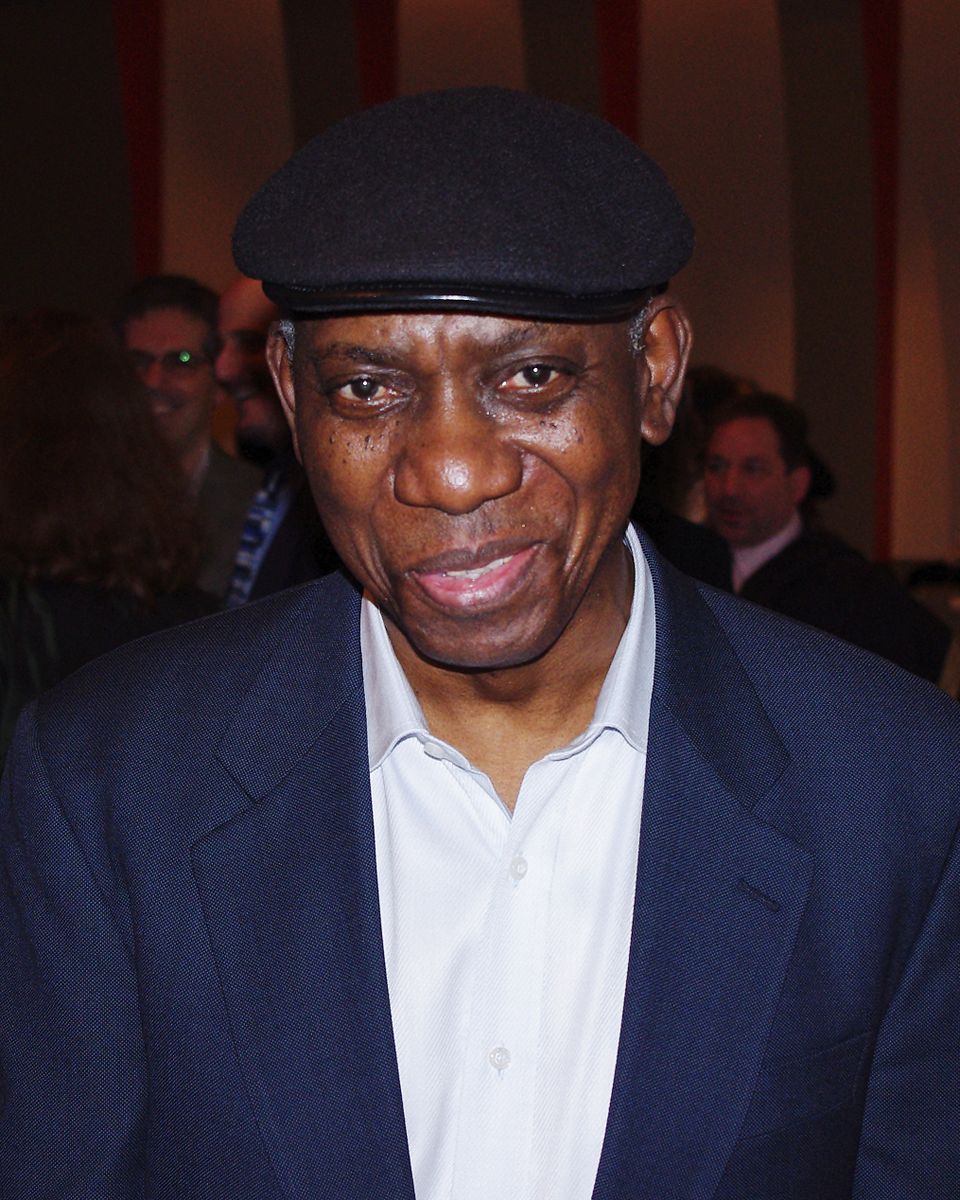
Yusef Komunyakaa is an American poet who teaches at New York University[5] and won the 1994 Pulitzer Prize for Poetry. He writes on the Black experience, rural Southern life before the civil rights movement, and his experience as a soldier during the Vietnam War.
Whilst so far this blog post has concerned itself with oral testimonies and artistic articulations of African-American political and cultural opinions, Andrew Hunt’s The Turning: A History of Vietnam Veterans Against the War provides important historical context for the reactions of African-American veterans. The organisation Vietnam Veterans Against the War played a key role in shaping public understanding of the conflict, and through understanding this organisation we can understand the changing opinions of the American public throughout the Vietnam War. Through events such as the Winter Soldier Investigation, veterans testified about atrocities committed in Vietnam, often presenting them as systemic rather than exceptional. Furthermore, African-American veterans were prominent within this movement, drawing attention to both racial discrimination and the ethical contradictions of the war. We are told that when news of the My Lai Massacre broke to the public on November 13, 1968, many chose to simply not believe what they were hearing.[15] However, for African-American’s, the news of the massacre may have been less surprising given their history of discriminatory and violent treatment. Crucially, I think it is important to distinguish that not all African-Americans should be seen as victims of a violent, imperial war machine, forced to sacrifice themselves for an unjust cause. The Turning also provides for us the perspectives of notable figures with authority too, such as Californian House of Representatives member Ron Dellums, an African-American Korean War veteran who was voluntarily arrested alongside hundreds of other peaceful war protestors present at Capitol Hill.[16]
When examined, these sources suggest that African-American responses to My Lai were shaped by lived experience along with a broader critique of American society. Rather than treating the tragedy as a singular event, many interpreted it as evidence of deeper structural problems. Ultimately, African-American reactions to the My Lai Massacre reveal a perspective that extends beyond immediate outrage to a wider critique of systemic violence. Through these examples of oral testimony, poetry, and political activism, we observe writers and veterans alike framing the massacre as part of a broader pattern of violence shaped by racism and inequality. I believe these unique interpretations helped challenge contemporary narratives that presented My Lai as an isolated event, instead placing it within the larger context of the Vietnam War and American society.
References
[1] PBS Frontline, “PBS Frontline: The Bloods of ‘Nam (1986),” hosted by Judy Woodruff, news segment, May 20, 1986, posted April 10, 2021, by FRONTLINE PBS I Non-Official Archive [CC], YouTube, 1:15:31, https://www.youtube.com/watch?v=RxSiLCIT0Ww.
[2] Wallace Terry, Bloods: Black Veterans of the Vietnam War: An Oral History (Ballantine Books Inc., 1985), 131.
[3] Terry, Bloods: Black Veterans of the Vietnam War: An Oral History, 14.
[4] Terry, Bloods: Black Veterans of the Vietnam War: An Oral History, 2.
[5] Terry, Bloods: Black Veterans of the Vietnam War: An Oral History, 14.
[6] Terry, Bloods: Black Veterans of the Vietnam War: An Oral History, 11-12.
[7] “Don’t Cry, Scream,” Haki R. Madhubuti, Poetry Foundation, accessed March 13, https://www.poetryfoundation.org/poems/162192/dont-cry-scream.
[8] Terry, Bloods: Black Veterans of the Vietnam War: An Oral History, 8.
[9] Yusef Komunyakaa, “You and I Are Disappearing” in Dien Cai Dau (Wesleyan University Press, 1988), 24.
[10] Yusef Komunyakaa, “Re-creating the Scene” in Dien Cai Dau (Wesleyan University Press, 1988), 26-27.
[11] Komunyakaa, “Re-creating the Scene,” 26-27.
[12] Komunyakaa, “Re-creating the Scene,” 26-27.
[13] Terry, Bloods: Black Veterans of the Vietnam War: An Oral History, 8.
[14] Komunyakaa, “Re-creating the Scene,” 26-27.
[15] Andrew Hunt, The Turning: a history of Vietnam Veterans Against the War (New York University Press, 1999), 35-36.
[16] Hunt, The turning: a history of Vietnam Veterans Against the War, 105-106.
No comments yet.